The Will to Power

Book Two: A Criticism of the Highest Values That Have Prevailed Hitherto
II: Criticism of Morality

§273   But do not let us fear: as a matter of fact, we require a great deal of morality, in order to be immoral in this subtle way; let me speak in a parable.

A physiologist interested in a certain illness and an invalid who wishes to be cured of that same illness, have not the same interests. Let us suppose that the illness happens to be morality — for morality is an illness — and that we Europeans are the invalid: what an amount of subtle torment and difficulty would arise supposing we Europeans were, at once, our own inquisitive spectators and the physiologist above-mentioned! Should we under these circumstances earnestly desire to rid ourselves of morality? Should we want to? This is of course irrespective of the question, whether we should be able to do so?

Posted in General | Leave a comment

Feel-the-love-love-love department, ctd

Remember that New Jersey church I pointed to a few months ago, which was buying-up tax liens then evicting people and selling the property?

They promised to quit once a local television station focused on their predation of the down-and-out, but apparently that promise was made with crossed-fingers.

Holy foreclosure: N.J. woman fights eviction
after church buys tax lien on property

Seriously: This is low by even the dismal standards of clergy. Next up, I imagine, is a stirring sermon about how the media attention constitutes persecution because ‘the world’ hates the baby Jesus, et cetera, et cetera.

Posted in General | Leave a comment

The Will to Power

Book Two: A Criticism of the Highest Values That Have Prevailed Hitherto
II: Criticism of Morality

§272 My desire is to show the absolute homogeneity of all phenomena, and to ascribe to moral differentiations but the value of perspective; to show that all that which is praised as moral is essentially the same as that which is immoral, and was only made possible according to the law of all moral development — that is to say, by means of immoral artifices and with a view to immoral ends, just as all that which has been decried as immoral is, from the standpoint of economics, both superior and essential; and how development leading to a greater abundance of life necessarily involves progress in the realm of immorality. “Truth” the extent to which we allow ourselves to comprehend this fact.

Posted in General | Leave a comment

April 11, 1945

The Nazi concentration camp at Buchenwald was liberated 70-years ago today.
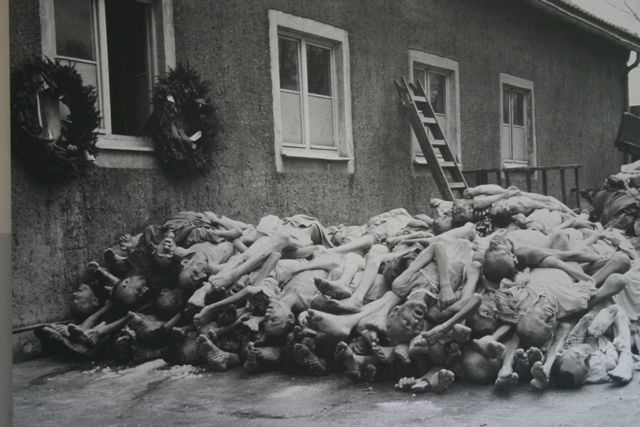
Exactly 16-years later the trial of Adolf Eichmann, the head of the Nazi concentration camp system, began in Israel.

The history of all this is too well-known to belabor; whole libraries can be filled with books about the Second World War, and more are published every year. I want to mention just two of those books, because they belong on every person’s lifetime reading list; if you haven’t read both, your education is incomplete.

The first is Hannah Arendt’s Eichmann in Jerusalem: A Report on the Banality of Evil, a compilation of the pieces she wrote for The New Yorker while covering the trial. From the time of its publication until her death, Arendt was obliged to defend that brilliant subtitle: A Report on the Banality of Evil. Arendt’s point was this: Eichmann was not the bigger-than-life monster one expects of the author of so much evil. He was, to the contrary, a pissant nobody, the nervous weeny we all knew in high school who would never get a date till the day he married some domineering virago. And when he said he was ‘just following orders,’ he meant it and was baffled by the outrage directed at him.

Eichmann was not an affirmatively evil man; he was an amoral schlub who did as he was told. If he had been told to make certain every Jew in Germany received a cake on his birthday he would have done that, instead of killing them, with exactly the same efficiency and indifference.

The moral of the story is this: Never outsource moral agency — not to your boss, not to some preacher or the Bronze Age goatherders he consults; doing that is the commonplace, and the banality, of evil.

Until the early 1930s, and in spite of the ravages of the Treaty of Versailles, Germany was universally admired for its contributions to the arts, mathematics, philosophy, science. Just how, the world wondered, had a country so advanced behaved with such depravity? Eric Hoffer went upstream of that question: What is a mass movement itself? His answer, published as The True Believer: Thoughts on the Nature of Mass Movements, was celebrated, forgotten, went out of print, then revived after the appalling events of September 11, 2001. It is indispensable to understanding the global Fundamentalist Rebellion against modernity, what drives it, and what is at stake.

Posted in General | 1 Comment

The Will to Power

Book Two: A Criticism of the Highest Values That Have Prevailed Hitherto
II: Criticism of Morality

§271   The predominance of moral values. The consequence of this predominance: the corruption of psychology, etc; the fatality which is associated with it everywhere. What is the meaning of this predominance? What does it point to?

To a certain greater urgency of saying No or Yes definitely in this domain. All sorts of imperatives have been used in order to make moral values appear as if they were forever fixed: they have been enjoined for the longest period of time: they almost appear to be instinctive, like inner commands. They are the expression of society’s preservative measures, for they are felt to be almost beyond question. The practice, that is to say, the utility of being agreed concerning superior values, has attained in this respect to a sort of sanction. We observe that every care is taken to paralyze reflection and criticism in this department: look at Kant’s attitude! Not to speak of those who reject as immoral all “inquiry” in these matters.

Posted in General | Leave a comment