
September 2026 S M T W T F S 1 2 3 4 5 6 7 8 9 10 11 12 13 14 15 16 17 18 19 20 21 22 23 24 25 26 27 28 29 30 FYI …
Visitor|at|BobFelton|dot|com
What do you know? My nephew, Ryan, has a byline in the U.S. edition of The Guardian.
Floyd Dent never felt pain like he did the night of 28 January.
At about 10pm, the Detroit native says he went to visit a blind friend in the neighboring city of Inkster, to deliver a bottle of Rémy Martin and a 40oz of Bud Ice. He stayed for a few minutes, then left to drive home.
Moments later, a police cruiser behind him flipped on its overhead lights.
Though the evolution of life is well established, one question has always remained unanswered: How did life itself begin? When, and how, did chemical compounds cease to be merely molecules and become living things?
Researchers may have solved origin-of-life conundrum
[ … ]
Chemists report today that a pair of simple compounds, which would have been abundant on early Earth, can give rise to a network of simple reactions that produce the three major classes of biomolecules—nucleic acids, amino acids, and lipids—needed for the earliest form of life to get its start. Although the new work does not prove that this is how life started, it may eventually help explain one of the deepest mysteries in modern science.
“This is a very important paper,” says Jack Szostak, a molecular biologist and origin-of-life researcher at Massachusetts General Hospital in Boston, who was not affiliated with the current research. “It proposes for the first time a scenario by which almost all of the essential building blocks for life could be assembled in one geological setting.”
Eat your heart out, Ken Ham.
The Godly folk have been unusually insistent this week that religion and morality have something to do with each other.
Phil Robertson soiled himself with a bizarre story intended to show that an atheist couldn’t object to the rape of his daughters and beheading of his wife.
An Arizona state senator thinks it would be a good idea to pass a law making attendance at the church of your choice compulsory, in order to promote “moral rebirth.”
Pollster George Barna, collaborating with oddity David Barton, has just had published a book which argues that — What do you know? — Americans need to turn their faces toward the Invisible Wizard if we are to avoid terrible judgments for Our Wickedness.
Rand Paul pronounced same-sex marriage to be the consequence of a “moral crises” which can be alleviated only by another “Great Awakening.”
Michigan’s Orleans Township Board determined that it ought to begin every meeting with a public prayer because one of the discomfort of one of its members: “It’s been bothering me, because in America in general, we’re doing so much to take God out of everybody’s life.”
But, of course, you may have all the god-god-god you want in your life; you just can’t use public money to insinuate Him into your neighbor’s life. But, as we shall see, we aren’t talking here about careful thinkers.
A Mississippi judge lets teenagers off the hook for their infractions if they write an essay about Revelation.
The unifying theme in these stories is clear: There is no morality without submission to a Supernatural Lawgiver.
Honestly, it baffles me that people don’t point and laugh when they hear nonsense like this. For starters, obviously, the clear premise of the claim is that humankind are incapable of moral reasoning — if it were otherwise, there would be no need for an Invisible Wizard to provide instruction. Fine. Let’s accept that premise.
What grounds could the Pious possibly have, then, for saying “God is good”? And what grounds could they have for claiming that Christinity’s ethical teachings are better than Islam’s, or Judaism’s, or Hinduism’s? How could they know, if humankind lacks the capacity for such judgments? And, given that, how do they know they are not the instrument of evil when they slavishly submit to the occult instructions found in an old book? The no-morality-without-god argument, a commonplace of Christian apologists, undercuts them right at the get-go by denying they have the capacity to even know what is good.
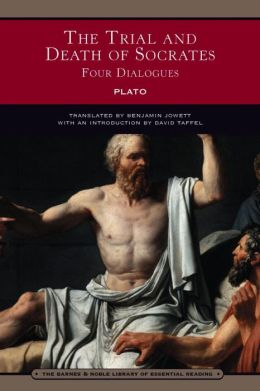
Setting aside that obvious, blinking-neon objection, it would do us no harm in these strident times to recall that Socrates put this whole ridiculous argument to rest 2400-years ago, when he met Euthyphro as he was entering court to answer Athens’ complaint that he was “corrupting the youth.”
Socrates is at court to answer a complaint, but Euthyphro is there to press murder charges against his father. A laborer killed one of the father’s slaves, and so the father bound the man and threw him in a ditch while he went to ask the priests what he should do; gagged, tied, and exposed to the weather, the man died. This leads to a discussion of what is right and wrong, and Socrates eventually springs this devastating question: “Is the pious loved by the gods because it is pious? Or is it pious because it is loved by the gods?” This is the hollow spot in divine command-and-control ethics. If the gods love a particular behavior because it is innately pious, then it must be so for some reason anterior to the gods. If, on the other hand, it is the fact that the gods love a behavior which makes it pious, then piety is nothing but the gods’ whims — and ultimately meaningless.
In other words, deferring to the wishes of an Invisible Wizard as the standard of morality achieves nothing but shifting responsibility; ultimately, it is just a device for evading moral responsibility.
Recall the recent case of American Baptist College, which invited a lesbian bishop to address the students. Yet another criticism of that decision was published just yesterday:
If we concerned pastors are guilty of “idolatry of the Bible” as Dr. Harris alleges, then what kind of idolatry is he guilty of? Has he elevated as synonymous with truth his opinion and the opinions of those who agree with him? A kind of idolatry of self? Do people like Dr. Harris and his allies discredit the Bible because they, in the words of Dr. Ben Carson, “need to remove any authority other than themselves as the arbiter of right and wrong?”
A statement from John R.W. Stott is compelling:
The Scriptures have the content, authority, and power for a proper evangelistic message. … God has clothed His thoughts in words, and there is no way to know Him except by knowing the Scriptures. [ … ] We can’t even read each other’s minds, much less what is in the mind of God.
If we are not to discern the mind of God on homosexual conduct from the Bible, where else are we to discern God’s mind on the subject? From the opinions of fallible, vacillating and “evolved” minds like those of Dr. Harris or Dr. McMickle, or any of the rest of us, or even of our President Obama?
The language is plain, and I have not overstated the premise: Humankind are not capable of moral reasoning. This is pure evasion and, at bottom, what Christianity demands is the abandonment of moral responsibility.
So of course the Godly preen about their virtue; how else can their childish evasions be hidden?
Book Two: A Criticism of the Highest Values That Have Prevailed Hitherto
II: Criticism of Morality§259 A point of view: in all valuations there is a definite purpose: the preservation of an individual, a community, a race, a state, a church, a belief, or a culture. Thanks to the fact that people forget that all valuing has a purpose, one and the same man may swarm with a host of contradictory valuations and therefore invite a host of contradictory impulses. This is the expression of disease in man as opposed to the health of animals, in which all the instincts answer certain definite purposes.
This creature full of contradictions, however, has in his being a grand method of acquiring knowledge: he feels the pros and cons, he elevates himself to Justice — that is to say, to the ascertaining of principles beyond the valuations good and evil.
The wisest man would thus be the richest in contradictions; he would also be gifted with mental antennae wherewith he could understand all kinds of men; and with it all he would have his great moments, when all the chords in his being would ring in splendid unison — the rarest of accidents even in us! A sort of planetary movement.