The Will to Power

Book Two: A Criticism of the Highest Values That Have Prevailed Hitherto
II: Criticism of Morality

§266   A. Morality as the work of Immorality.

  1. In order that moral values may attain to supremacy a host of immoral forces and passions must assist them.

  2. The establishment of moral values is the work of immoral passions and considerations.

B. Morality as the work of error.

C. Morality gradually contradicts itself. Truthfulness, Doubt, Judging, the “Immorality “of belief in morality. The steps.

  1. Absolute dominion of morality: all biological phenomena measured and judged according to its values.

  2. The attempt to identify Life with morality (symptom of awakened scepticism: morality must no longer be regarded as the opposite of Life); many means are sought even a transcendental one.

  3. The opposition of Life and Morality. Morality condemned and sentenced by Life.

D. To what extent was morality dangerous to Life?

  1. It depreciated the joy of living and the gratitude felt towards Life, etc.

  2. It checked the tendency to beautify and to ennoble Life.

  3. It checked the knowledge of Life.

  4. It checked the unfolding of Life, because it tried to set the highest phenomena thereof at variance with itself.

E. Contra-account: the usefulness of morality to Life.

  1. Morality may be a preservative measure for the general whole, it may be a process of uniting dispersed members: it is useful as an agent in the production of the man who is a “tool”.

  2. Morality may be a preservative measure mitigating the inner danger threatening man from the direction of his passions: it is useful to “mediocre people?

  3. Morality may be a preservative measure resisting the life-poisoning influences of profound sorrow and bitterness: it is useful to the “sufferers?

  4. Morality may be a preservative measure opposed to the terrible outbursts of the mighty: it is useful to the “lowly?
Posted in General | Leave a comment

Say again?

Today is Easter and, all over the world, men are waking-up and realizing that the Li’l Woman is going to drag he and the children to church today, and there is nothing he can do about it unless he is prepared to get a divorce. Once there, they will be subjected to the claim that “Jesus rose from the dead,” and “Jesus triumphed over death,” and so forth.

Aiming, perhaps, to help shape today’s sermons, Albert the Pious went so far just yesterday as to humiliate himself by publishing this egregiously false, but typical, claim:

The resurrection of Jesus Christ from the dead separates Christianity from all mere religion — whatever its form. Christianity without the literal, physical resurrection of Jesus Christ from the dead is merely one religion among many. “And if Christ is not risen,” said the Apostle Paul, “then our preaching is empty and your faith is in vain.” Furthermore, “You are still in your sins!.” Paul could not have chosen stronger language. “If in this life only we have hope in Christ, we are of all men the most pitiable.”

Yet, the resurrection of Jesus Christ has been under persistent attacks since the Apostolic age. Why? Because it is the central confirmation of Jesus’ identity as the incarnate Son of God, and the ultimate sign of Christ’s completed work of atonement, redemption, reconciliation, and salvation.

Sigh. The humdrum truth is that dying-and-rising gods were such a commonplace in the ancient world that Jesus would never have gained entrée to the god-club if he hadn’t died and come back, and mythologists have wondered whether such nonsensical stories ought to comprise a distinct category.

Undoubtedly, the resurrection narratives of Jesus — and there are a bunch — are fakelore, stories made-up to make him appear more like a genuine-article god to people steeped for millennia in tales of gods who died and returned from death.

iconiconThe howling and bellowing pastor in the little white church down the street knows that perfectly well, too, if he has had a proper seminary education, for it is simply not true that Christianity popped-up out of nowhere one day, like a mushroom. The birth of Christianity is a point on the continuum of religious thought; it had antecedents in other, pre-existing religions, and it has spawned offshoots of its own. Indeed, many serious-minded scholars wonder whether Jesus ever even existed, because the entire Jesus narrative can be constructed from previous materials. (I incline toward the view that, Paul Bunyan-like, there probably was a human being around whom the tall-tales gathered, mainly because I have a difficult time imagining a strong Jesus-movement without a historical figure. There is no — NO — contemporaneous evidence that Jesus ever existed.)

All of which raises a troubling question: Why is the truth so often the exact opposite of the claims made by pastors? Why, if they are the keepers and guardians of the Eternal Truth, do they need to lie?

Posted in General | 3 Comments

The Will to Power

Book Two: A Criticism of the Highest Values That Have Prevailed Hitherto
II: Criticism of Morality

§265   There seems to be no knowledge or consciousness of the many revolutions that have taken place in moral judgments and of the number of times that “evil” has really and seriously been named “good“. I myself pointed to one of these transformations with the words “The morality of custom.” Even conscience has changed its sphere: formerly there was such a thing as a pang of conscience in the herd.

Posted in General | Leave a comment

The Will to Power

Book Two: A Criticism of the Highest Values That Have Prevailed Hitherto
II: Criticism of Morality

§264   How false and deceptive men have always been concerning the fundamental facts of their inner world! Here to have no eye; here to hold one’s tongue and here to open one’s mouth.

Posted in General | Leave a comment

You-can’t-make-this-stuff-up department, ctd

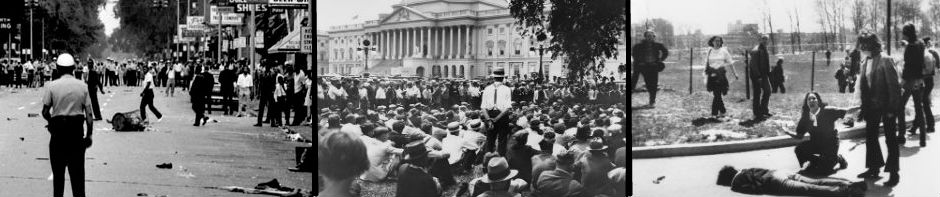
A publicist for Liberty Counsel thinks believers should descend upon Indianapolis and piteously bleat that good, decent, Godly people are being treated just like blacks have been treated in Ferguson, Missouri. As Dave Barry says, “I am not making this up.”

Can conservatives responding to the recent controversy in Indiana over religious freedom learn anything from liberals about messaging? After the Michael Brown shooting, liberal leaders from the left, such as Al Sharpton and Jesse Jackson, and secular progressive communities from across America seized the opportunity and flocked to Ferguson, Missouri, to take over the narrative, blaming Brown’s death on “institutional racism.” Universities as far away as George Mason University in Fairfax, Virginia, held diversity discussions. College students from all over the country joined the crowds walking the streets chanting “Hands up, don’t shoot.”

Today, the church must contend for the faith and the faithful in like manner. What churches and religious universities will take a page out of the liberal playbook to rally, to march, to hold candle vigils and to speak out? What pastors will go to Indianapolis to stand by Gov. Mike Pence and the Religious Freedom Restoration Act? Which organizations will help pay the way for those victimized by religious intolerance – bakers, photographers, venue owners – to make their way to Indianapolis? When will we as a church begin matching our words with action? If not now, then when?

Just in case there is some damn fool somewhere in America who still can’t see what conservative evangelicals actually are, some blinkered idiot who hasn’t yet detected the blinking-neon malice — I hope they do that.

Posted in General | Leave a comment