The Will to Power

Book Two: A Criticism of the Highest Values That Have Prevailed Hitherto
V: The Moral Ideal

§343   An ideal which is striving to prevail or to assert itself endeavours to further its purpose (a) by laying claim to a spurious origin; (b) by assuming a relationship between itself and the powerful ideals already existing; (c) by means of the thrill produced by mystery, as though an unquestionable power were manifesting itself; (d) by the slander of its opponents ideals; (e) by a mendacious doctrine of the advantages which follow in its wake, for instance: happiness, spiritual peace, general peace, or even the assistance of a mighty God, etc. Contributions to the psychology of the idealists: Carlyle, Schiller, Michelet.

Supposing all the means of defence and protection, by means of which an ideal survives, are discovered, is it thereby refuted? It has merely availed itself of the means by which everything lives and grows — they are all “immoral”.

My view: all the forces and instincts which are the source of life are lying beneath the ban of morality: morality is the life-denying instinct. Morality must be destroyed if life is to be liberated.

Posted in General | Leave a comment

Dismal theology tweet for the day: Catch-22 Edition

The catch? According to the SBC, the priesthood of the believer is vested exclusively in the pastor, who is the expert on what is and is not false teaching.

WHEREAS, The doctrine of the priesthood of the believer can be used to justify the undermining of pastoral authority in the local church.

Be it therefore RESOLVED, That the Southern Baptist Convention, meeting in San Antonio, Texas, June 14-16, 1988, affirm its belief in the biblical doctrine of the priesthood of the believer (1 Peter 2:9 and Revelation 1:6); and

Be it further RESOLVED, That we affirm that this doctrine in no way gives license to misinterpret, explain away, demythologize, or extrapolate out elements of the supernatural from the Bible; and …

Basically, if you don’t catch Pastor Bubba with his pants down — literally, and not even then if it involves children — you’re stuck with him.

This reminds me of Albert the Pious’ teaching that there’s no right to leave a church except for false teaching.

Seriously: Why does anybody regard these self-aggrandizing hot dogs as anything but objects of ridicule? All I can think is that it takes of lot of insecurity to be a good Southern Baptist.

Posted in General | Leave a comment

The Will to Power

Book Two: A Criticism of the Highest Values That Have Prevailed Hitherto
V: The Moral Ideal

§342   A. The consistent type understands that even evil must not be hated, must not be resisted and that it is not allowable to make war against one’s self; that it does not suffice merely to accept the pain which such behaviour brings in its wake; that one lives entirely in positive feelings; that one takes the side of one’s opponents in word and deed; that by means of a superfetation1 of peaceful, kindly, conciliatory, helpful and loving states, one impoverishes the soil of the other states — that one is in need of a perpetual way of living. What is achieved by this? The Buddhistic type, or the perfect cow.

This point of view is possible only where no moral fanaticism prevails, that is to say, when evil is not hated on its own account but because it opens the road to conditions which are painful (unrest, work, care, complications, dependence).

This is the Buddhistic point of view: there is no hatred of sin, the concept “sin”, in fact, is entirely lacking.

Per the OED, ‘superfetation’ means “Additional or superabundant production or occurrence; the growth or accretion of one thing on another; an instance of this; an accretion, an excrescence.”

Posted in General | Leave a comment

Moral progress and rebuking history

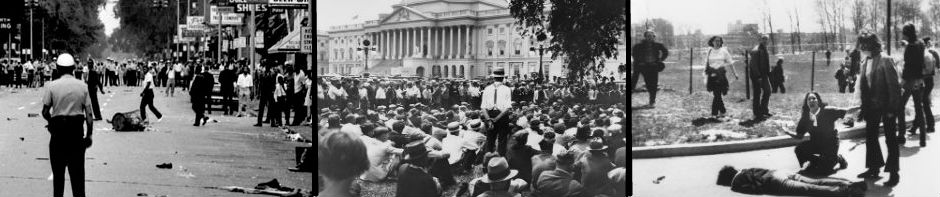
I think it is better to rebuke history than whitewash it, and for that reason I am opposed to the widespread clamor for universal elimination of the Confederate flag and renaming buildings which honor those we now know to be criminals. Better they remain as sores in plain public view, the evil they symbolize the object of frank public contempt.

The question arises, of course, in consequence of the gratuitous slaughter last week of nine innocent black churchgoers by Dylann Roof. That happened, in Jeri Massi’s apt phrase, within an “instrastructure of tradition” that includes egregious racism, a crude religiosity that unambiguously endorsed slavery, and extreme right-wing ideologies intensified into nearly incoherent madness by election of a black president. Now, a sane world which has blissfully ignored the lunacy festering in the south appears to believe that eliminating the symbols will eliminate the problem they nurture.

No. The infrastructure of tradition does not change because everybody politely agrees to not notice or discuss the unpleasantness; it changes when there is moral leadership that unapologetically condemns the evil and forces its hideousness into public view. Rather than lowering the Confederate flag and removing South Carolina’s monument to its Civil War dead, Governor Haley could more usefully (and cheaply) hire an architect to retrofit the monument with markers setting-out and renouncing that state’s shameful race-based misbehaviors and vowing it will not happen again.

In a similar vein, Southern Seminary has been confronted with demands that it rename certain campus buildings which honor the founders of the Southern Baptist Convention, many of whom were themselves slaveholders and foaming-at-the-mouth racists who held that blacks bear the mark of Cain. Albert Mohler, the seminary’s president, tap-danced around the problem yesterday, saying at last that he would not change the building’s names even as he characterized those they honor as heretics. If the Southern Baptists were not the authors of so much human misery, I would almost feel sorry for him; after all, he is between the proverbial rock and a hard place. He operates within an infrastructure of religious tradition which has long been the primary engine of southern racism and, however desperately its leadership wishes to change that because it is indispensable to the denomination’s very survival, the laity who pay his salary and once threw rocks at the freedom marchers aren’t going to be good sports about being told they were and are wildly, morally, wrong.

He has a further problem: The Southern Baptists, often with unseemly aggressiveness, claim to be the keepers and guardians of Eternal Truth — which cannot lightly be updated. Nevertheless, he should do exactly the same thing Governor Haley should do: He should leave the building names unchanged and cause to be built at some prominent place on campus a marker or exhibit which expressly declares “This is who we once were, a people who honored those &#$!@ racists …”

A bit of historical perspective, and an awareness of the dangers of self-righteous certitude, would not be a bad thing for seminarians to learn.

The philosopher Peter Singer characterizes moral progress as enlarging the circle of us to include them, as expanding the Golden Rule to cover the others, too. On this definition, which I accept, it was moral progress when we ceased to burn witches and heretics at the stake, it was moral progress to strike down the Jim Crow laws, it was moral progress to cease treating women as chattel, and it will be moral progress when gays are left alone to spend their Life, Liberty, and Pursuit of Happiness as they see fit.

It is slow, it is haphazard, it is countered by reaction at every step — but I believe nonetheless in the reality of moral progress; most of us have seen it within our own lifetimes. That comes, though, only with frank acknowledgment of wrongdoing, not with the polite pretense that it never happened, never existed, and why should we speak of unpleasant things anyway? Now is the time for Haley and Mohler — Mohler, an educator, especially — to exploit the opportunity afforded by the awful events in Charleston to exercise genuine-article moral leadership and drag the evil of racism into the public square and publicly strangle it.
Posted in General | 10 Comments

The Will to Power

Book Two: A Criticism of the Highest Values That Have Prevailed Hitherto
V: The Moral Ideal

§341   The origin of the ideal. The examination of the soil out of which it grows.

A. Starting out from those “aesthetic” mental states during which the world seems rounder, fuller and more perfect: — we have the pagan ideal with its dominating spirit of self-affirmation (one gives –). The highest type: the classical ideal regarded as an expression of the successful nature of all the more important instincts. In this classical ideal we find the grand style as the highest style. An expression of the “will to power” itself. The instinct which is most feared dares to acknowledge itself.

B. Starting out from the mental states in which the world seemed emptier, paler and thinner, when “spiritualisation” and the absence of sensuality assume the rank of perfection and when all that is brutal, animal, direct and proximate is avoided (people calculate and select): the “sage”, “the angel”, priestly = virginal = ignorant, the physiological ideals of such idealists: the anaemic ideal. Under certain circumstances this anaemic ideal may be the ideal of such natures as represent paganism (thus Goethe sees his “saint” in Spinoza).

C. Starting out from those mental states in which the world seemed more absurd, more evil, poorer and more deceptive, an ideal cannot even be imagined or desired in it (people deny and annihilate); the projection of the ideal into the sphere of the anti-natural, anti-actual, illogical; the state of him who judges thus (the “impoverishment” of the world as a result of suffering: people take, they no longer give): the anti-natural ideal.

(The Christian ideal is a transitional form between the second and the third, now inclining more towards the former type and now inclining towards the latter).

The three ideals: A. Either a strengthening of Life (paganism), or B. an impoverishment of Life (anaemic) or C. a denial of Life (anti-naturalism). The state of beatitude in A. is the feeling of extreme abundance; in B. it is reached by the most fastidious selectivity; in C. it is the contempt and the destruction of Life.

Posted in General | Leave a comment