
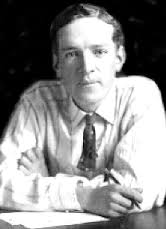
Upton Sinclair, b. 1878-Sep-20

  • I aimed at the public’s heart, and by accident I hit it in the stomach.

  • I know you are brave and unselfish people, making sacrifices for a great principle but I cannot join you. I believe in the present effort which the allies are making to suppress German militarism. I would approve of America going to their assistance. I would enlist to that end, if ever there be a situation where I believe I could do more with my hands than I could with my pen.

  • American capitalism is predatory, and American politics are corrupt: The same thing is true in England and the same in France; but in all these three countries the dominating fact is that whenever the people get ready to change the government, they can change it.

  • All art is propaganda. It is universally and inescapably propaganda; sometimes unconsciously, but often deliberately, propaganda.

  • It is difficult to get a man to understand something, when his salary depends upon his not understanding it!

  • The American People will take Socialism, but they won’t take the label.

  • Man is an evasive beast, given to cultivating strange notions about himself. He is humiliated by his simian ancestry, and tries to deny his animal nature, to persuade himself that he is not limited by its weaknesses nor concerned in its fate. And this impulse may be harmless, when it is genuine. But what are we to say when we see the formulas of heroic self-deception made use of by unheroic self-indulgence? What are we to say when we see asceticism preached to the poor by fat and comfortable retainers of the rich? What are we to say when we see idealism become hypocrisy, and the moral and spiritual heritage of mankind twisted to the knavish purposes of class-cruelty and greed?

  • The first thing brought forth by the study of any religion, ancient or modern, is that it is based upon Fear, born of it, fed by it — and that it cultivates the source from which its nourishment is derived.

  • In the most deeply significant of the legends concerning Jesus, we are told how the devil took him up into a high mountain and showed him all the kingdoms of the world in a moment of time; and the devil said unto him: “All this power will I give unto thee, and the glory of them, for that is delivered unto me, and to whomsoever I will, I give it. If thou, therefore, wilt worship me, all shall be thine.” Jesus, as we know, answered and said “Get thee behind me, Satan!” And he really meant it; he would have nothing to do with worldly glory, with “temporal power;” he chose the career of a revolutionary agitator, and died the death of a disturber of the peace. And for two or three centuries his church followed in his footsteps, cherishing his proletarian gospel. The early Christians had “all things in common, except women;” they lived as social outcasts, hiding in deserted catacombs, and being thrown to lions and boiled in oil.

    But the devil is a subtle worm; he does not give up at one defeat, for he knows human nature, and the strength of the forces which battle for him. He failed to get Jesus, but he came again, to get Jesus’ church. He came when, through the power of the new revolutionary idea, the Church had won a position of tremendous power in the decaying Roman Empire; and the subtle worm assumed the guise of no less a person than the Emperor himself, suggesting that he should become a convert to the new faith, so that the Church and he might work together for the greater glory of God. The bishops and fathers of the Church, ambitious for their organization, fell for this scheme, and Satan went off laughing to himself.

  • Journalism is one of the devices whereby industrial autocracy keeps its control over political democracy; it is the day-by-day, between-elections propaganda, whereby the minds of the people are kept in a state of acquiescence, so that when the crisis of an election comes, they go to the polls and cast their ballots for either one of the two candidates of their exploiters.

  • In the course of my twenty years career as an assailant of special privilege, I have attacked pretty nearly every important interest in America. The statements I have made, if false, would have been enough to deprive me of a thousand times all the property I ever owned, and to have sent me to prison for a thousand times a normal man’s life. I have been called a liar on many occasions, needless to say; but never once in all these twenty years has one of my enemies ventured to bring me into a court of law, and to submit the issue between us to a jury of American citizens.

  • Birth control is one of the great fundamental achievements of human reason, as important to the life of mankind as the discovery of fire or the invention of printing. Birth control is the deliverance of womankind, and therefore of mankind also, from the blind and insane fecundity of nature, which created us animals, and would keep us animals forever if we did not rebel.

Posted in General | Leave a comment

Back in the ol’ hometown, ctd

Notice the bars over the window and door openings. It’s well-intended, I suppose, but I couldn’t be paid to live that way.

Posted in General | Leave a comment

New! Improved! More inerrant than ever!

Introducing Felton’s Dictum, or, The Drunk College Boys Test

It hasn’t drawn much media attention in this dismal season of waiting to see what stupid and repellent thing Donald Trump will say next, but Crossway has just announced a new edition of the English Standard Version Bible. What is more, after more than 1800-years of fine-tuning, it is the last translation.

Yes! Previous versions were of course inerrant and totally true and trustworthy, but this edition is r-e-e-e-a-l-l-y inerrant and totally true and trustworthy! It is s-o-o-o inerrant and totally true and trustworthy that the business of translation is closed. Forever. There is no longer a need. There will be no more translations.

Beginning in the summer of 2016, the text of the ESV Bible will remain unchanged in all future editions printed and published by Crossway—in much the same way that the King James Version (KJV) has remained unchanged ever since the final KJV text was established almost 250 years ago (in 1769). This decision was made unanimously by the Crossway Board of Directors and the ESV Translation Oversight Committee. All future Crossway editions of the ESV, therefore, will contain the Permanent Text of the ESV Bible—unchanged throughout the life of the copyright, in perpetuity.

Y’all will not be surprised to learn that this interests me.

In 1670, an (already-)excommunicated Dutch Jew named Baruch Spinoza published a book entitled Tractatus Theologico-Politicus, which set out the principles of interpreting ancient texts. Basically, Spinoza said, the ancient texts should be understood as they would have been understood in the time and place they were written. This seems commonsensical today, but the idea was novel then and drew the wrath of the Roman Church. Though he clearly was one of the greatest intellects of his day, the idea died aborning and Spinoza died in obscurity.

Critical scholarship was revived in Germany in the 1850s and, as everybody knows, library shelves now groan with catalogs of blinking-neon contradictions and historical errors, and the answers of theologians anxious that the Bible continue to be received as ‘inerrant’ and their own authority as guides to the headache-inducing ‘mysteries’ (e.g., boo-boos) preserved.

Critical scholarship has stimulated a great deal of Bible-translation work, too. After all, if ongoing scholarship reveals that everybody knew that X was too-friendly with Z‘s wife, then there are grounds for wondering whether verse such-and-such means this or means that. And so on. As angry as they were when he introduced the idea, Spinoza’s Tractatus could justly be re-titled The Case for Eternal Busywork for Theologians.

And that’s before we get to the problem that the accepted meaning of words change over time. We have all had the experience of encountering something in the KJV of 1611 and wondering, “What the hell does that mean?” So too, inevitably, the ESV of 2016; the day unavoidably will arrive when its language will be obscure to readers.

Honestly, it is such a bizarre announcement, an announcement so wildly out-of-step with the established norms of Biblical scholarship, that I wonder if it constitutes a de facto concession that their schtick is failing so fast that there is unlikely to be any interest in a new translation 20-years from now. I mean, hell — not even many Christians actually read that ridiculous old book today.

But I am, as is well-known, extremely wicked, et cetera, et cetera, so take that idle speculation for what it’s worth.

No matter, we have at last the t-r-u-u-u-l-y inerrant version of the Bible — whatever that means. After all, the inerrant version isn’t the texts we actually possess. No. The inerrant version is the ‘original autographs’ of the texts we possess, the texts produced by the author’s very own personal hand. Those copies are long gone, and there is no reasonable expectation that they will ever be encountered. (And I call ‘bullshit’ on the claim that the copies we have are good enough, that the important stuff was magically preserved. After all, the oldest copy of Mark famously does not include the ending of Chapter 16, where the stuff about snake-handling is found. The oldest extant copy of Luke does not contain verse 23:34. “Father, forgive them …” And there are, oh, thousands of like, but less well-known, other examples.)

Nor does anybody know who wrote the canonical Gospels, or anything about their authors except what the authors themselves tell us. Mark, for instance, might have been a traveling companion of Peter, as the text seems to claim, but we know so little about Mark that he might actually have been a committee of drunk college boys who just wanted to see what they could get away with. I am not saying that’s the case, but that there is no — NO. — justification for claiming Mark is inerrant if you can’t show even that much about its provenance.

Therefore, Felton’s Dictum, and don’t bother me with jabbering about inerrancy and the expectations of Our Invisible Friend unless you can overcome it.

  1. IF you possess a known-to-be mangled, umpteenth-generation copy of an ancient text …

  2. OF unknown provenance, and …

  3. THAT text makes all sorts of fantastic, wildly implausible claims, and …

  4. YOU can’t even prove it wasn’t written by a bunch of drunk college boys out to excite the rubes, and …

  5. YOU claim it is inerrant, or without error, and …

  6. PROPOSE to rely upon it to justify constricting your neighbor’s life, then …

  7. YOU are …

    • AN odious fool, and …

    • NOT entitled to expect educated, decent-minded grown-ups to take you seriously.

  8. CASE closed.

Bah.

Posted in General | 1 Comment

Dismal theology-related tweet for the day

There are people who want to make other people’s life harder for no other reason than
to be able afterwards to offer them their recipe for alleviating life (for example their Christianity).

Friedrich Nietzsche
Human, All Too Human, §555

Seroiusly: You do not want some godly moron underhandedly messing around with your life for your own good. Put them as remote from you as you possibly can.

UPDATE:   Apparently, the importance of being willing to ‘wound’ your friends for their own good is the theme of the day.

Posted in General | Leave a comment

Tweet-storm of the day

Posted in General | Leave a comment