
Character in the pulpit

Former pastor Bruce Gerencser reprises today a familiar subject hereabouts: Biblical inerrancy.

Many Evangelical pastors know the Bible is not inerrant. Privately, they will bitch and complain about Bible thumpers such as Ken Ham, David Barton, Jerry Falwell, Jr, James Dobson, Tony Perkins, James Robison, Jim Bakker, and Bob Gray Sr. They wish these men would shut the darn, freaking, heck up. However, when these very same swearing preachers enter their pulpits on Sunday, they sing a different tune, leading congregants to believe that the translations they hold in their hands are the inspired, inerrant, infallible Words of God. These liars for Jesus know that telling people that the Bible contains errors, mistakes, and contradictions would lead to conflict, unrest, membership loss, reduced offerings, and perhaps even unemployment.

I live just a few miles from Southeastern Baptist Theological Seminary, and operated a used bookstore directly across the street from the seminary for a couple of years; I got to know a lot of seminarians.

Some seminarians, I am convinced, are so dumb that they actually do believe the Bible is inerrant — but many, probably a majority, are not that stupid. What they are is … trapped. The Southern Baptists encourage young marriage and swift procreation. By the time an eager-beaver young seminarian puts together all the disparate strands of subject matter that comprise his education, and figures-out what a cynical scam evangelical Christianity really is … there are mouths to feed and the wife — herself raised to be preacher’s helpmeet — has no intention of staying in married student housing long enough for him to change fields and study something actually useful.

So he spends the rest of his life standing in a pulpit telling lies and battling depression and being ridiculed by people like me. Ultimately, the issue is character, and evangelical Christianity conspires against character.
Posted in General | Leave a comment

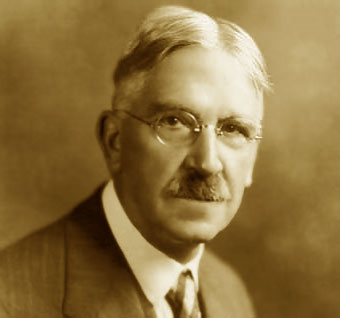
John Dewey, b. 1859-Oct-20

One of the most influential men of his time, and an architect of the “American Century,” John Dewey was the man behind the curtain as the Progressive Era undid the predations of the Gilded Age and constructed the now-declining middle class.

Dewey was a pragmatist, a school of philosophy which places primacy upon experience and rejects Platonism unconditionally. It is not a set of metaphysical claims so much as a habit of thought, and all engineers and scientists are trained by default to the pragmatic approach to problem-solving: Think first, believe later.

  • It is no accident that all democracies have put a high estimate upon education; that schooling has been their first care and enduring charge. Only through education can equality of opportunity be anything more than a phrase. Accidental inequalities of birth, wealth, and learning are always tending to restrict the opportunities of some as compared with those of others. Only free and continued education can counteract those forces which are always at work to restore, in however changed a form, feudal oligarchy. Democracy has to be born anew every generation, and education is its midwife.

  • Every thinker puts some portion of an apparently stable world in peril and no one can wholly predict what will emerge in its place.

  • Legislation is a matter of more or less intelligent improvisation aiming at palliating conditions by means of patchwork policies.

  • It is a familiar and significant saying that a problem well put is half-solved.

  • In the late eighteenth and the greater part of the nineteenth centuries appeared the first marked cultural shift in the attitude taken toward change. Under the names of indefinite perfectibility, progress, and evolution, the movement of things in the universe itself and of the universe as a whole began to take on a beneficent instead of hateful aspect.

  • The revolution in scientific ideas just mentioned is primarily logical. It is due to recognition that the very method of physical science, with its primary standard units of mass, space, and time, is concerned with measurements of relations of change, not with individuals as such.

  • This idea is that laws which purport to be statements of what actually occurs are statistical in character as distinct from so-called dynamic laws that are abstract and mathematical, and disguised definitions. Recognition of the statistical nature of physical laws was first effected in the case of gases when it became evident that generalizations regarding the behavior of swarms of molecules were not descriptions or predictions of the behavior of any individual particle. A single molecule is not and cannot be a gas. It is consequently absurd to suppose that a scientific law is about the elementary constituents of a gas. It is a statement of what happens when a large number of such constituents interact with one another under certain conditions.

  • The mystery is that the world is at it is — a mystery that is the source of all joy and all sorrow, of all hope and fear, and the source of development both creative and degenerative. The contingency of all into which time enters is the source of pathos, comedy, and tragedy.

  • Surrender of individuality by the many to someone who is taken to be a superindividual explains the retrograde movement of society. Dictatorships and totalitarian states, and belief in the inevitability of this or that result coming to pass are, strange as it may sound, ways of denying the reality of time and the creativeness of the individual.

  • The ground of democratic ideas and practices is faith in the potentialities of individuals, faith in the capacity for positive developments if proper conditions are provided. The weakness of the philosophy originally advanced to justify the democratic movement was that it took individuality to be something given ready-made, that is, in abstraction from time, instead of as a power to develop.

  • To regiment artists, to make them servants of some particular cause does violence to the very springs of artistic creation. But it does more than that. It betrays the very cause of a better future it would serve, for in its subjugation of the individuality of the artist it annihilates the source of that which is genuinely new. Where the regimentation is successful, it would cause the future to be but a rearrangement of the past.

  • Education is not preparation for life; education is life itself.

  • Education, therefore, is a process of living and not a preparation for future living.

  • We only think when we are confronted with problems.

Posted in General | Leave a comment

Quote for the day

When Trump attacked Khizr Khan before the 2016 presidential election, anyone decent and moral should have known all they needed to know about Trump and should have voted for anyone other than Trump.

Michael Hamar

I feel about the same way — there just isn’t any good excuse for not knowing what a godawful anti-American liar and scam-artist Donald Trump is. He made clear his contempt for the First Amendment freedoms of speech, the press, and religion, long before the election; his shabby business conduct was well-documented; his serial lies were the subject of public wonder.

The people who voted for Trump knew who he was — and have no excuse.

Posted in General | Leave a comment

Quote for the day

Trump did nothing. The plan to take both Mosul and Raqqa was initiated under Obama, and Trump famously refused to approve a new plan for months because the military kept telling him that Obama’s approach was working. So he put them off and put them off until he finally approved a plan in August that was mostly the same as the plan we already had. And now he’s claiming that this new plan turned things around in eight weeks.

I know we don’t expect anything else from Trump. But he can always be even worse than you think, can’t he? Hell, he didn’t even give the military any credit, let alone Obama. What a jackass.

Kevin Drum Mother Jones

Posted in General | Leave a comment

Meet my neighbors, ctd

Pastor removes 5-year-old boy’s grave marker after payment dispute

Posted in General | Leave a comment